How to Optimize CUDA Matrix Multiplication
CUDA GPU
Source: How to Optimize a CUDA Matmul Kernel for cuBLAS-like Performance: a Worklog
Overview
This article walks through optimizing matrix multiplication (matmul) in CUDA from scratch, starting with a basic implementation and progressively improving it until reaching 95% of cuBLAS performance.
Key Concepts
What is SGEMM? Single-precision (32-bit float) General Matrix Multiply - performs C = αAB + βC
Why it matters: Matrix multiplication is the most important algorithm in modern deep learning, making up almost all computations during training and inference.
Test setup: Multiplying 4092×4092 matrices on an A6000 GPU (30 TFLOPs theoretical peak)
The Optimization Journey
Kernel 1: Naive Implementation
- Performance: 309 GFLOPs (1.3% of cuBLAS)
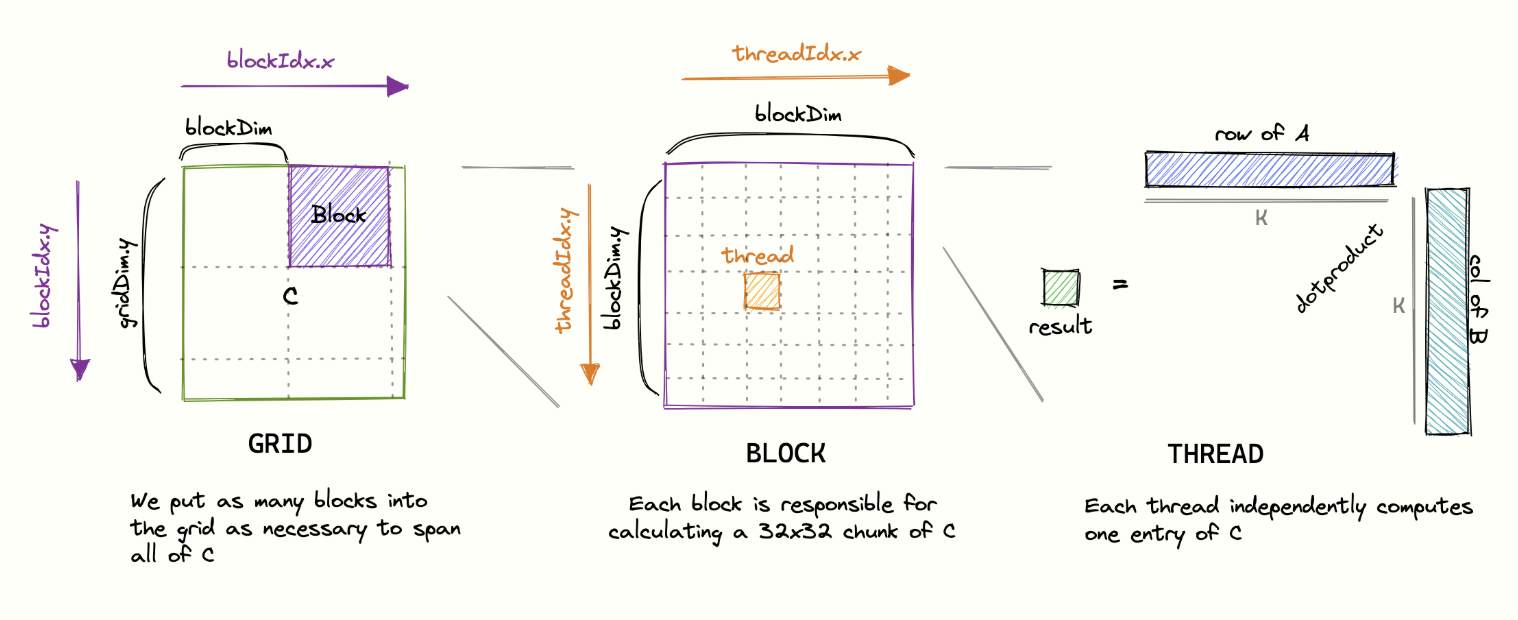
- Approach: Each thread calculates one output element
- Problem: Terrible memory access patterns - threads load data inefficiently
Kernel 2: Global Memory Coalescing
- Performance: 1,987 GFLOPs (8.5% of cuBLAS)
- Improvement: Reorganized how threads access memory so consecutive threads read consecutive memory locations
- Key insight: GPUs can combine multiple small memory reads into one large read when addresses are consecutive
Kernel 3: Shared Memory Caching
- Performance: 2,980 GFLOPs (12.8% of cuBLAS)
- Approach: Load chunks of data into fast on-chip “shared memory” that all threads can access
- Key insight: Shared memory is 16x faster than global memory
Kernel 4: 1D Block Tiling
- Performance: 8,475 GFLOPs (36.5% of cuBLAS)
- Approach: Each thread now calculates 8 output elements instead of 1
- Key insight: Reduces memory accesses per result because data can be reused
Kernel 5: 2D Block Tiling
- Performance: 15,972 GFLOPs (68.7% of cuBLAS)
- Approach: Each thread calculates an 8×8 grid of outputs (64 elements)
- Key insight: Computing a square of results allows even more data reuse than computing a column
Kernel 6: Vectorized Memory Access
- Performance: 18,237 GFLOPs (78.4% of cuBLAS)
- Approach: Load 4 floats at once instead of 1 at a time
- Key insight: Memory systems work most efficiently when loading larger chunks
Kernel 9: Autotuning
- Performance: 19,721 GFLOPs (84.8% of cuBLAS)
- Approach: Automatically test different block sizes to find the best configuration
Kernel 10: Warp Tiling
- Performance: 21,779 GFLOPs (93.7% of cuBLAS)
- Final optimization: Organize work at the “warp” level (groups of 32 threads)
Main Lessons
-
Memory is the bottleneck: Early kernels were limited by how fast they could fetch data, not by computation speed
-
Data reuse is critical: Computing more results per thread means you can reuse loaded data more times
-
Hardware details matter: Understanding warps (groups of 32 threads), shared memory, and memory coalescing is essential
-
Progressive optimization works: Each optimization built on the previous one, with clear performance improvements at each step
The Final Result
Starting from 309 GFLOPs with a naive implementation, the optimized kernel reached 21,779 GFLOPs - a 70x speedup and 93.7% of professional library performance!
Article by Simon Boehm, December 2022
Full code available on GitHub